
The Tiny Tool That Didn’t Work.
Day 8 of building a tiny workflow efficiency tool per day (using AI to code the product).

I want to tell you about a product I’m NOT releasing.
Most of what I’ve been building this past week has impressed me. I’ve been able to use AI to help code me browser based tools that solved tiny workflow problems, quickly, cleanly. They can work off-line, and don’t need AI or API’s to run.
I’d brief a product idea in, Claude codes it, we iterate a few rounds, and the product would appear. And that work flow is what built a kind of momentum this past week and a bit.
Have I grown over-confident? Maybe.
The feeling you get when you’re on a roll (and the ideas are just coming) is nice to have. But this feeling can run away from you if you’re not carful.
Here’s the build diary I’m not too excited to share. Day 8 hasn’t gone to plan. But, for the sake of transparency in this challenge, I will share the what, why and what it means for this 10-in-10 challenge. ↓
Day 8 was spent ‘trying’ to build KitPress
The idea for this tool made perfect sense to me.
Musicians and songwriters often need an Electronic Press Kit (an EPK as it’s known) that they can share with venues, PR contacts, and anyone in the industry sizing them up.
It’s basically a one-page snapshot.
Your genre, your stats, a testimonial or two, some upcoming gigs, social handles, contact links. The equivalent of a PDF landing page that you can email out.
And the standard way to make one involves Canva (or some other subscription tool) -or someone else doing it for you if you’re not used to design tools.
I wanted to make something simpler.
A tool you’d set up once, fill in the blanks every now and then, and export to PDF. With the ability to work offline (for those on-the-tourbus-with-no-wifi updates you might need to make). It’s standalone as a tiny product (with no subscription needed).
I’d already built that kind of PDF output into other tools this week, so I knew it was possible.
I thought KitPress was going to be an easy tiny tool to build and run.
It wasn’t. :-(
Feeling clunky
Every version of this tool that was iterated felt clunky!
Elements wouldn’t line up properly (but had on other tools I’ve built in this 10-day-challenge).
If you had a long artist name, or email (which I do with my own music) the formatting would break.
Things that had worked cleanly in earlier tools were suddenly crushing together, not fitting, not behaving. And I was confused by this. The same approach, the same kind of brief, but a completely different result.
I went to version 8 of this product iteration. Still not right!
And like all good product owners ….. at some point … I started blaming the AI!
It wasn’t getting what I was saying.
It kept missing the brief.
I’d load in reference files, try different angles, but something was always off.
Then I stepped back. And I realised the problem wasn’t the AI. The problem was that I was trying to solve a problem that has many solutions already.
Canva already does this.
Google Slides already does this.
What I’d built was - and I’m being honest when I use the phrase ‘at best’ - was a low-quality version of a one-page design tool.
Like a reinvention of the wheel, except the wheel I’d made was square.
(You could say that realising this meant was the case was really annoying having wasted the time in the process).
The solution I was trying to build didn’t fit the actual issue.
A Canva template given away free would’ve done more good for a musician than what I was building. (And it would’ve taken less time).
The scope had crept too.
I kept adding things to make it seem better and more useful. Like gig listings, toggle options, image scaling, even base64-embedded social icons. All of it technically interesting, but none of it solving the core problem better than tools that already exist.
I found myself building complexity into something that needed to be simple. Building a tool around a problem that was already solved.
Now, I don’t like leaving things unfinished. That’s probably what kept me pushing through the eight versions I did instead of stepping back sooner.
It felt like a personal thing. Like I might be giving up too soon.
But, there’s a difference between not finishing and actually recognising that the thing you’re building isn’t the right thing to build at all.
Not spotting this by that point cost me time.
And, safe to say I won’t be releasing Kitpress. As it’s just not the calibre of tool I wanted to make. And you can do a better job solving your EPK needs using other tools.
Here’s a screenshot of the interface. And where I’d built it to at the point of stopping. You might spot some of the issues in the layout here.
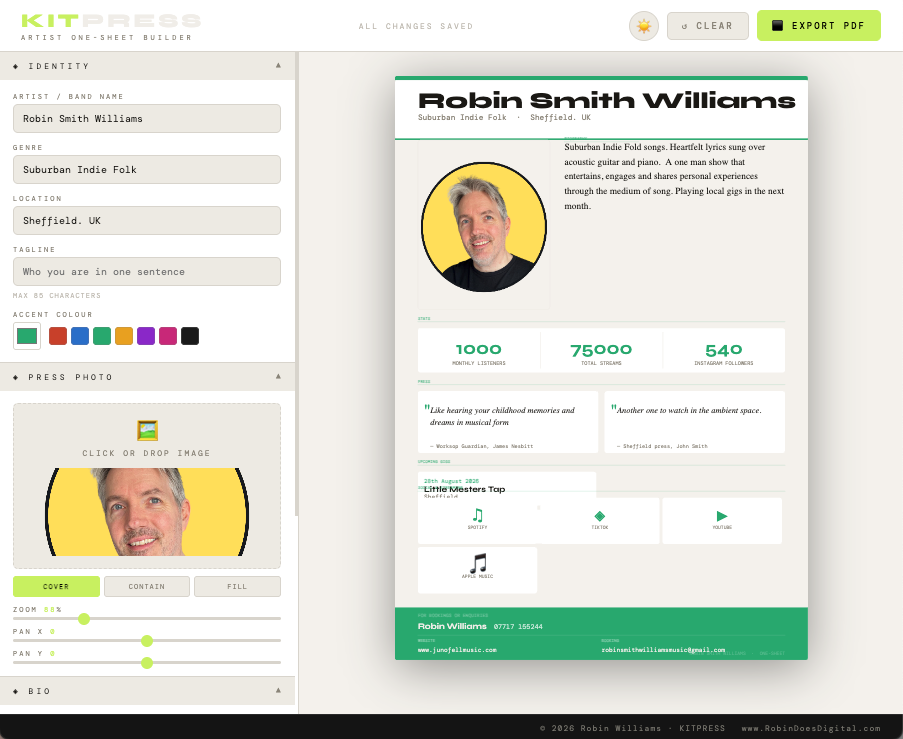
NOTE: Those numbers in there are NOT my real streaming and followers (unfortunately). I was testing loads of different numbers to make sure larger stream numbers had space on the page.
You can see there’s crushing up in the top section of the text.
I have a long name on my music channel. This was problematic. I don’t know how bands like ‘And you will know them by the trail of dead’ would cope.
The lower sections shows gigs crushed up by social links.
I’d used embedded symbols - because default icons for streaming channels was causing things to look odd
The layout flow - for some reason - kept hitting the same bugs and issues, even on iterations where I’d instructed changes to be made to ratio’s instead of fixed border points.
… There was a lot of things!
Not taking this bad product experience to heart
What I did get out of it, weirdly, was clarity about what does work.
The tools that I loved most this week were the ones dealing with fixed, repeatable content.
A defined input, a defined output. The ones that struggled in the build stage were trying to handle too many variables. With too many user cases to be considered. Or they were filling up with too much user-specific design requirements in the options section of the browser tools.
For musicians specifically, something like a ‘split sheet’ (which is a document used for splitting songwriting royalties between collaborators) would be a much better fit for a product I reckon. As it required the same types of fixed fields, and needs a consistent structure. It’s something people genuinely search for - and if they don’t use a tool - they tend to do badly at keeping the same process (or avoid using them entirely).
I think areas like this are where a small standalone tool makes more sense to develop.
Right now, I’m still figuring out which of the ideas from this sprint have legs beyond the ten days. A few of them do, but they might need more consideration around how I market them.
What I am sure of is that KitPress isn’t going to be one of them I’ll promote or offer.
Note to self would be:
“Not every idea deserves to become a product. And knowing that sooner is better.”
Two more days to go.
Let’s see if I can get back on track and move past this bad product experience.
-R
Wondering what all this 10-by-10 product building is about?
Jump to the first post in this series - where I talk about why AI’s got me worried (as a GenX creative). :-)