
I built a lead generation arcade game.
Here’s how it actually got inspired and built (in one day).

I was at the Sheffield Showcase event a short time ago. It was a busy event. I went along to visit a business my friends runs. And whilst I walked the floor, I couldn’t help but notice something about the way most of the stands were approaching their lead generation opportunities for the event.
It was pretty basic. The types of tactics you’d expect. Business cards in little bowls. QR codes on the table top. I even saw a couple using paper sign-up sheets with email addresses written in biro. It was all pretty un-inspired.
I know people are doing their best at events like these. But, I also used to work in events. And standing there in 2026, watching people try to spark conversations on a busy floor, I kept thinking back to one lead gen ‘play’ we used that worked well back in 2009.
Games!
TL:DR - there’s a video lower down the page that walks you through this, and the reasons. If you’re pushed for time go check that out (4-mins).
Fishing for leads
I spent around 5 years working in global pharmaceutical marketing (between 2007 and 2012). With lots of events and stands to design marketing and sales tools for during that time.
The type of attendees this places get are formal. Suits, lanyards, the full corporate detail and branding on everyone’s clothes.
If I’m honest about it, they always tended to feel ‘stuffy’.
But, on one of our stands, a sales rep had the idea of bringing out a kids’ fishing game. They had it in their car, as they had young kids. They just remembered this was still in the car.
It was one of those tabletop ones (where you try to hook the little plastic fish before time runs out).
It sounds ridiculous. And it kind of was. But, we set it up to give us something different to try and get people to stop by the stand.
At first, people walked past and the bright colours caught their eye. You could see them pause slightly
“is that a kid’s fishing game?”, someone asked.
Yes, so they had a go. And then something weird happend … people queued up to play next.
Suits and all!
They’d beat someone’s score and let them know it. That meant the other person could come back to the stand wanting another go.
We pulled together a leaderboard sheet. And put the points on there. People dropped their business cards (that’s what everyone had back them). Global brands logo’s jockeying for position on the leaderboard positions as we shuffled the cards whenever someone new beat an existing score.
But wierder still …people would hang around to watch. And then - almost accidentally - they’d start talking to each other, and to us. Whilst they waited to see if anyone beat their score.
The barriers to having conversations at the stand just opened up.
Scores went into a prize draw. All cards went into a box with any notes added via sticker labels about the person, their questions, their scores - to be added into a CRM with that event’s name on it back in the office.
We generated leads. Lots of them.
But really what we had was something better than cold leads, we had conversations that didn’t feel forced!
Conversations about that event, that ended up leading to sales conversations.
That was over 15 years ago. I assumed by now that many businesses would have something in place to help this process.
At that Sheffield event, there were only a few ‘stand challenges’ (for team building services mostly, and one drop-catch game for an escape rooms - as they were offering coorporate event deals). But most stands had nothing except a bit of ‘giveaway’ merch.
There was a snooker table in the chill area. A table for hot drinks. People standing around doing the polite networking shuffle. Some good stands, some good conversations. But no one was playing anything.
My journey home took an hour. During which my mind had some time offline to do more thinking.
The brief in my head was simple:
Can I create something competitive, time-limited, and offline-capable to solve this opportunity for event stands?
Events charge through the nose for reliable wifi (and even then it’s patchy). Whatever idea I was thinking about, it needed to run offline. No app download. No login. And handle lead gen data with some consideration of GDPR and safety.
The next morning, I opened Claude and got started!
Building STANDGAME
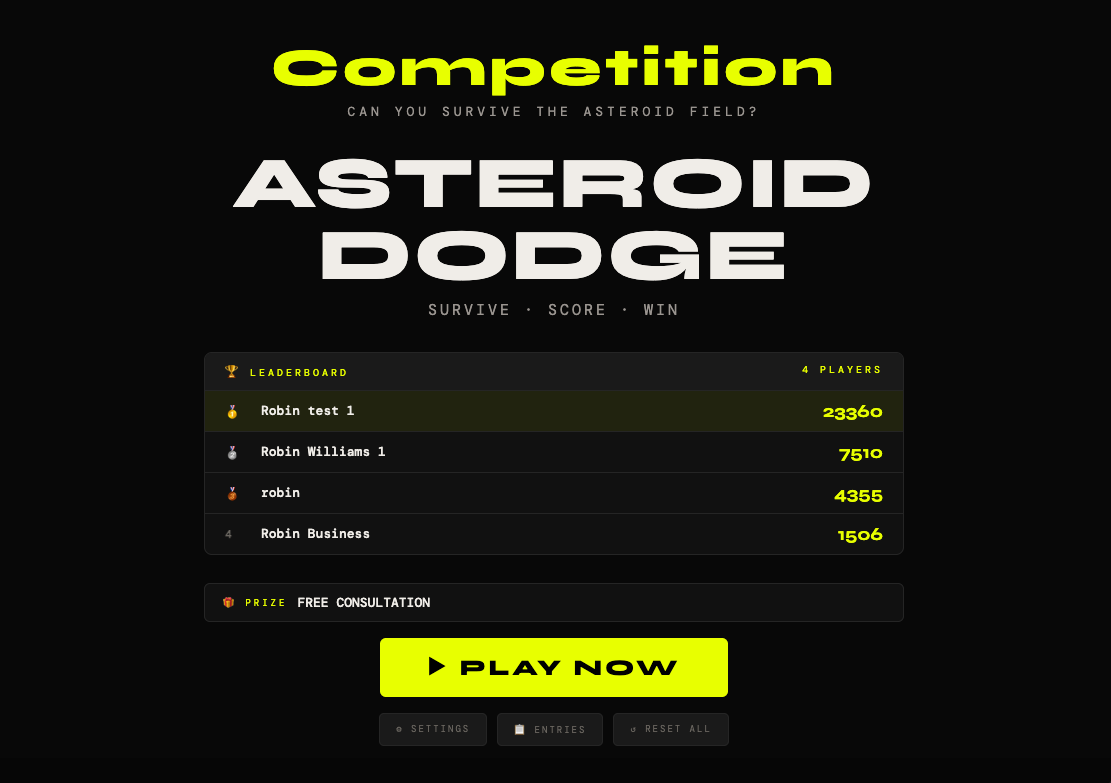
The build was pretty swift. The brief in my head took around 20 minutes to shape into a prompt. Which Claude building in about 5 minuted. And the first version was around 80% there. But the iterations and fine tuning for user experience and playability is what took most of the day. Meaning it took around seven versions to get to the finished point.
Now, I’d already defined a strong design brief document (from my structured AI process update) that Claude uses at the start of any build. This is set up in the project folder. This design doc and the instructions means Claude can easily handle the visual decisions quickly, so I’m not pixel-pushing to design before building.
And time wise for this one-product-per-day challenge, I had no time (or intention) in designing graphics too.
There’s a bunch of game types I can choose from
I looked at building a side-scroller game first. For a retro experience - with some figure moving about. But, side scrolling approach requires design for it’s images, background, sprites, and animation. I needed something simple, but playable.
Then I remembered about my childhood and playing the Vectrex.
If you don’t know it - a Vectrex was like a mini arcade console for your home (available in the late 80s) that ran games entirely built using vector graphics.
Vectors are lines and shapes. No bitmaps. It’s technically limited animation, but it visually distinctive. Think ‘old-school’ asteroids, linear cars, trangle shaped aircraft games. Each catridge game was a different vector based game. Limited, but very fun!
There’s something about that line drawn aesthetic that works visually in technology and public spaces. Clean lines, with high-contrast colours. Which, on a big screen or stand screen - makes your space more eye-catching. And if large enough, makes it easy to see there’s a playable game from a distance. Especially useful when you’re walking around a crowded event space.
Asteroids made sense for my purposes. And it pays homage to many, many wasted hours of game playing I ‘invested’ in, during my childhood.
Claude got the tool built quickly once I described these game constraints.
However, the first couple of versions I played on were far too slow.
My son and I play a lot of Splatoon. The beauty of this paint the space game is their strict three-minute challenge rounds. The shorter limit works.
But on a stand, with no chairs, and people waiting for their turn - 3 minutes is a long time?
You’d lose half the queue before the first game finished!
So I decided to use 60 seconds as the default time, with a 90 and 120 second option just in case it was a slow event.
Faster levels, and I added optional difficulty. That meant kids could play it (on hard levels), adults could play it (on simple), and nobody had to stand there watching for too long.
You could generate around 25–50 leads per hour - if you are running people back-to-back like the fish game used to.
And for a simple lead gen activity at events, that’s not a bad afternoon’s marketing!
Here’s the quick walk through video I made on that day showing the use and setup.
AI overlooked the data and GDPR issue
One thing AI didn’t catch in the build process was how to best handle data access. GDPR means I need to make sure this tool complies with some best practice.
The game captures personal lead info like name & contact details. And originally, Claude built it so I could click a menu and choose to look at the data.
But when the options menu opened, the list of player data was visible. And, on a stand, with a screen people can wander past and glance at, that’s not acceptable. You can’t just have people’s contact details sitting there in the open.
I also had to get Claude to add a GDPR consent checkbox when adding your details. This would create a time stamp and date capture. Which I need to have as a data processor. So if anyone in my emails complains in the future about how I got their details, I can share the event time, and pass this info into my CRM when loading up the leads from each event.
I caught these GDPR issues whilst testing the iterations. I flagged it, and Claude fixed it quickly.
I also suggested we add a confirmation button which created a gate for the data. A small thing - that only the game operator would know how to click it. And a simple password to view this.
Problem averted, and a more secure lead capture is in place.
It’s a good reminder that AI moves fast and doesn’t always stop to think about the human (and legal context) around what it’s being asked to build. That’s still my job to prompt correctly. So if I didn’t know about the issue, I wouldn’t spot the potential data weak point.
My advice, run this past another person if you’re building anything that handles people’s data. And ask them to stress test getting access to the data. That’ll show the issues you need to add into the next prompt.
Play is a good business relationship builder
There’s a bigger point to the tool than just the data is captures every 60-seconds.
Play disarms people. People buy from People!
Business events are essentially rooms full of strangers who are supposed to trust each other enough to do business together.
I don’t know about you. But to me that’s always been a strange thing to ask of people in one short afternoon. And most of the sales mechanics businesses typcially use - the pitch, the brochure, the “what do you do?” - are all a bit performative (or awkward).
But, if you just beat someone’s high score?
Or they beat yours?
You’ve already got something real to talk about. It’s not as forced to start a conversation. The ice is already broken.
Looking at the opportunity missed beyond the stand, at Sheffield there was a chill zone. With snooker table, drinks, somewhere to breathe. That could’ve had something running in there to help people disarm via a challenge.
Something with a shared leaderboard across the whole event. I’d use it as a way to see who actually showed up and took the challenge (not just who registered). Which offers a different kind of engagement data set for the organisers.
I didn’t build that deeply. I only had one day thanks to the rules in this challenge. But I’ve been thinking about it since. And would consider how to put something in place if I organised events like this.
Am I reinventing the wheel?
Maybe.
There are services that do brandable event games. They’re not cheap. And they can take time to organise and arrange before an event.
What I built instead was my ‘low-rent’ version. Something that could be on event team’s laptops ready and waiting whenever they need it. Turn up, plugin in, play!
I built this, partly because I wanted to see if I could, and partly because it suits where I am at this point in the 10-day challenge.
With one day to design, build, test. I feel this is a tiny workflow efficiency tool solving a real world problem. Lead gen is something many businesses struggle with. Events is where many business feel compelled to explore. I’m pleased with this as a solution.
I’ve made a user guide available with the tool. As there’s more explaination to run people through for how to set up, re-name to their brand and add prize information. Plus, they’ll need to know how to access the data, and pick a winner. Useful elements, but these could be confusing. The PDF is there as a quick guide instead of any email support for questions.
GAMESTAND runs offline, exports to CSV, and takes about two minutes to set up. And it’s cheaper than a ‘posh’ sandwich.
I think it adds a fun way to help people engage with your brand. It can also help you start some serious business conversations.
If you’re curious, there’s a walkthrough video on my LinkedIn post about this build. Or use the link below to grab your own version.

Further game development
I’m still figuring out what this becomes beyond the challenge. But the lead generation tool angle is something I’ve not explored up to this point in the challenge. And the game mechanics that these lightweight file tools offer is decent. I’ll have to explore this in more detail once the challenge is done (and I have more time).
3-days left, and 3 more products to build.
I liked the fun element of this one. Game mechanics are quite a powerful business tool application. There’s definitely more to explore in this realm of tools.
Wondering what all this 10-by-10 product building is about?
Jump to the first post in this series - where I talk about why AI’s got me worried (as a GenX creative). :-)